
Polish Mortgage 2025–2026: Conditions and Opportunities for Foreigners
 29.03.2026
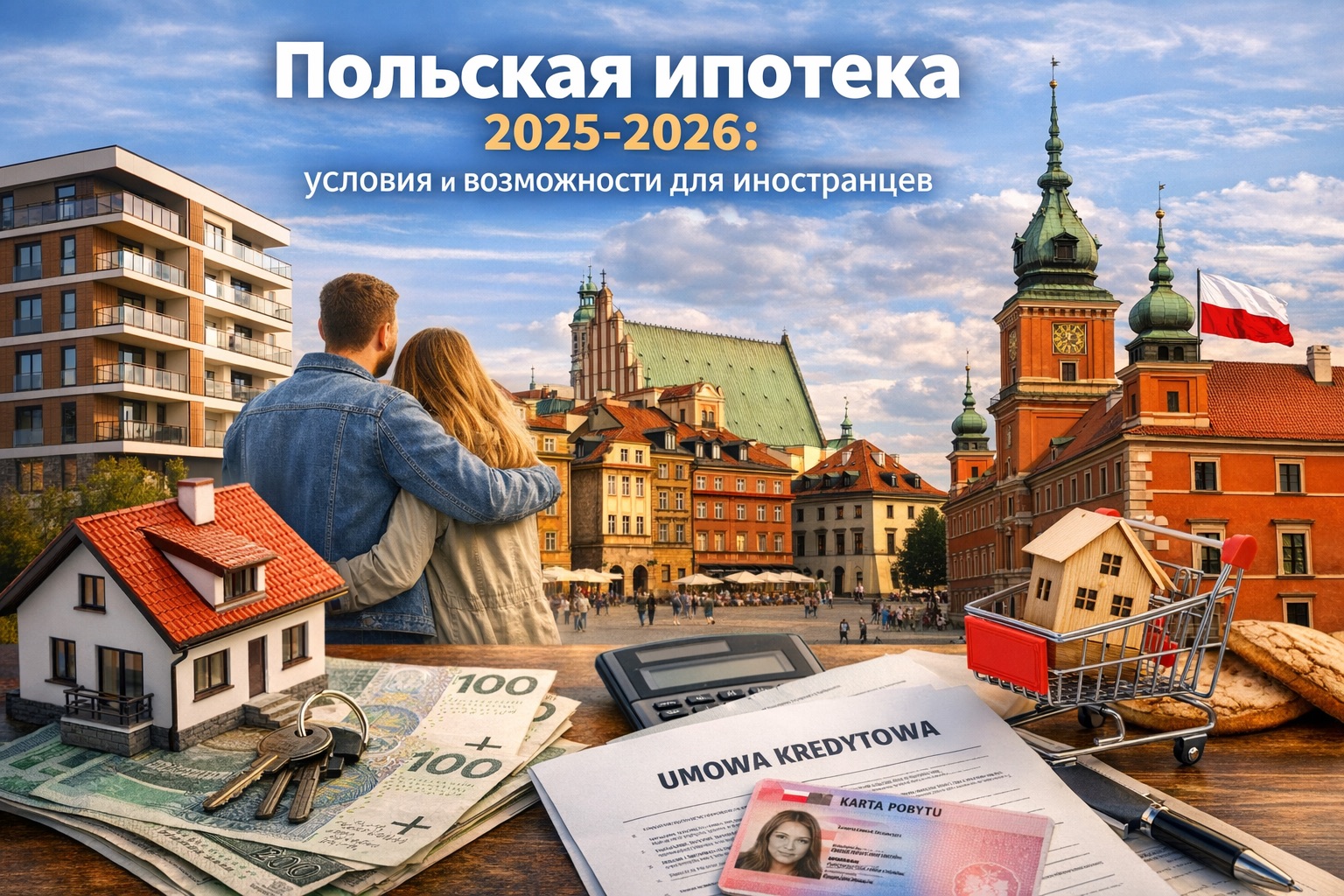
Polish Mortgage: Conditions for Foreigners
Poland remains an attractive country for purchasing real estate: housing demand remains consistently high, the market is stable, and price growth is moderate and predictable. Polish mortgages are becoming increasingly popular among foreigners, especially families and professionals planning long-term residence in the country. In many cases, a mortgage proves to be a more reasonable alternative to renting: instead of paying for rental housing for years and eventually moving out, the buyer gradually repays the loan and after 20 years becomes the full owner of their own apartment.
Foreigners are increasingly choosing mortgages in order not to freeze the entire amount at once and at the same time invest in their own housing. In this article, we will examine what types of mortgages in Poland are available to foreigners today, which banks actually issue mortgage loans to foreign citizens, under what conditions, and what documents are required.
The Okeask team supports clients at all stages of the purchase: we help select optimal mortgage programs, work with banks, advise on requirements, and simultaneously select the best real estate options for a specific budget and goals — whether it is buying an apartment for personal living or for long-term investment.
How mortgages work in Poland
Mortgages in Poland are structured in a fairly clear and transparent way, especially for those who have already dealt with European banking systems. Housing loans are issued in Polish zloty — this is the main currency used by almost all banks. Mortgages in euros are less common and are most often available to citizens of EU countries who earn income in foreign currency.
Who can get a mortgage?
-
Citizens of EU countries — on equal terms with Polish citizens, especially if they have income in Poland.
-
Foreigners with a residence card (temporary or permanent).
-
Non-residents without a residence card — less common, but possible, especially with stable official income in Poland and an opened bank account.
Banks primarily assess creditworthiness — a stable income is required (preferably earned in Poland), employment history, no outstanding debts, and a clean credit history. Some banks also accept income from abroad, but conditions in such cases are stricter.
The average mortgage term ranges from 20 to 30 years. Early repayment is possible, but during the first 3 years the bank may charge a fee (on average 2–3%). The down payment starts from 10% and higher, depending on the borrower’s status and the type of property.
A Polish mortgage is a real way to buy an apartment in Poland in installments, especially if you plan to live in the country or rent out the property. The key is proper preparation and choosing a bank willing to work with foreigners. The Okeask team fully supports this process: from selecting a bank and mortgage program to choosing an apartment and supporting the transaction.
Mortgage conditions for foreigners
It is possible to obtain a mortgage in Poland even without citizenship, but the rules for foreigners are stricter than for local residents. Banks carefully verify documents, income, and residence status — the clearer your situation, the higher your chances of approval.
Here are the main conditions:
Down payment
For foreigners, it is usually higher. While EU or Polish citizens may qualify with 10–15%, applicants without Polish citizenship are more often required by banks to provide 10–30% of the property value. This serves as a form of risk mitigation for the bank.
Stable income
A confirmed official income is mandatory, most often from Poland. In some cases, banks accept foreign income (for example, from the EU or the UK), but under less favorable conditions.
Proof of legal residence
Almost all banks require a residence card (temporary or permanent). Without it, obtaining a mortgage in Poland is difficult, but not impossible — with high income, a good credit rating, and an opened account in a Polish bank, there is still a chance.
Employment contract and banking history
It is advisable to have an employment contract for at least 6–12 months ahead and a positive credit history (in Poland or abroad). Self-employed individuals can also apply, but more documentation will be required.
A mortgage in Poland for foreigners is a reality, but it requires preparation: legal status, documents, and transparent income. Obtaining a loan without a residence card is rather the exception than the rule, and such cases require an individual approach.
Interest rates
In Poland, mortgages are most often issued with a variable interest rate, but banks are increasingly offering fixed-rate options — especially for the initial years of lending.
Variable rate
Linked to the WIBOR index (in the future — WIRON), plus the bank’s margin. This means the rate may change every 3–6 months depending on decisions of the National Bank of Poland. Such loans currently make up the majority of the market — they often start with a lower rate but carry the risk of future increases.
Fixed rate
Usually offered for a period of 5–10 years. The rate is slightly higher than the variable one but provides stability and protection from market fluctuations. This is a popular choice among those planning early repayment within several years.
Rates in 2025
Over the past two years, mortgage rates in Poland reached 8–9% per annum, but a gradual decrease is expected in 2025. Banks are already offering loans at 6.5–7.5%, and by 2026 the market forecasts rates at 5.5–6%, provided inflation remains under control.
Conclusion: the choice between fixed and variable rates depends on strategy — whether you prefer predictability or are willing to take risks in exchange for lower payments. In any case, mortgage interest rates in Poland directly depend on central bank policy and economic conditions, so monitoring trends is essential.
Possibility of changing banks and refinancing a mortgage
It is important to understand that a mortgage in Poland is not a “sentence” for the entire loan term. Borrowers have the right to change banks and refinance their mortgage at any time if more favorable conditions appear on the market. This is a common practice, especially over long horizons of 20–30 years.
Refinancing allows you to:
-
reduce the interest rate,
-
lower the monthly payment,
-
switch from a variable rate to a fixed one (or vice versa),
-
combine the mortgage with other credit obligations.
Refinancing usually becomes particularly relevant several years after taking out the loan — for example, when interest rates decrease or the borrower’s financial situation improves. However, additional costs should be considered: property valuation, notary services, and possible early repayment fees during the first years.
The Okeask team supports clients not only at the mortgage approval stage but also afterward — we monitor market conditions and, if necessary, advise on changing banks and refinancing so that the mortgage remains as advantageous as possible throughout its entire term.
What documents are required for a mortgage
To obtain a mortgage in Poland, a foreigner must prepare a set of documents confirming identity, income, and the property itself. Banks approach this strictly but without unnecessary bureaucracy — the key is clarity and transparency.
Required documents include:
Passport and proof of legal stay
-
Foreign passport
-
Residence card (temporary or permanent) or a valid visa with the right to live and work
Income documents
-
Employment contract (for at least 6–12 months ahead)
-
Bank account statement for the last 3–6 months
-
PIT declarations (tax returns) for the previous year, if available
-
For entrepreneurs — extracts from CEIDG/KRS and income calculations for 12 months
Property documents
-
Preliminary sale agreement (Umowa przedwstępna) or reservation agreement
-
If the property is under construction — a developer agreement and project documentation
Additionally
-
PESEL (if available)
-
Employer’s certificate (Zaświadczenie o zatrudnieniu i dochodach)
-
Spouse’s consent, if you are married (even if the spouse does not participate in the loan)
Important: each bank may slightly vary its requirements, but the general principle is the same — to confirm identity, stable income, and the legal status of the purchased property.
If you plan to take out a mortgage in Poland, it is best to collect all documents in advance and, if possible, consult with a mortgage broker. This saves time and increases the chances of approval.
Is it possible to buy an apartment in Poland with a mortgage without a residence permit
Yes, a mortgage in Poland without a residence card is possible — but this is not a standard scenario, rather an exception for solvent investors. Banks are far more willing to work with those legally residing in the country, but under certain conditions they may also consider non-residents.
What to consider:
High down payment
Without a residence card, the bank will almost certainly require 30–40% of own funds to compensate for its risks. The higher the amount, the higher the likelihood of approval.
Additional guarantees
Without official residence in Poland, lenders need more reassurance. Banks often require:
-
stable income, preferably in an EU currency
-
ownership of property or business assets in Poland or Europe
Buying an apartment in Poland without a residence card is realistic, especially if you view the property as an investment and are ready to make a significant down payment.
Advantages and risks for foreigners
A Polish mortgage for foreigners is not only a way to purchase housing but also an opportunity to invest in a stable and transparent market. However, alongside the advantages, there are certain limitations that should be considered before signing the agreement.
Advantages
-
Stable economy and predictable conditions
Poland is part of the EU, has a stable banking system, and reliable regulation. Interest rates change gradually without sharp fluctuations, and the market operates under transparent rules. -
Property value growth
Especially in Warsaw — where demand for real estate consistently exceeds supply. This makes purchasing an apartment through a mortgage a strong investment tool. -
Rental income to offset mortgage payments
In large cities, the rental market is active, and in many cases tenant payments fully or partially cover the monthly mortgage installment.
Risks and disadvantages
-
Bureaucracy and differing bank requirements
Each bank sets its own conditions: one requires a residence card, another a guarantor. Document preparation may be prolonged, especially if income is earned outside Poland. -
Currency fluctuations
If your income is in euros, dollars, or another currency while the mortgage is in zloty, exchange rate changes can affect the real cost of repayments — especially in cases of early repayment or resale. -
Additional costs
Insurance, property valuation, notary fees, and loan issuance commissions can add 4–7% (or sometimes more) to the total transaction cost.
A mortgage in Poland for foreigners is a practical tool when approached thoughtfully. Weigh the advantages, account for the risks, and prepare for the nuances in advance — and the purchase will proceed smoothly and profitably.
Conclusion
Polish mortgages are becoming increasingly understandable and accessible for foreigners. Banks are more accommodating, and the OKEASK real estate agency offers stable conditions and a wide range of properties — from new developments in Warsaw to cozy rental apartments in university cities.
The key is not to proceed blindly. Prepare documents, compare offers, verify the property, and work with reliable partners. Then a mortgage in Poland will cease to be a bureaucratic quest and become a normal, well-calculated step — both for living and for investment.

Blog
Residential price index in Poland in the second quarter of 2023
08.02.2024Residential price index in Poland in the second quarter of 2023
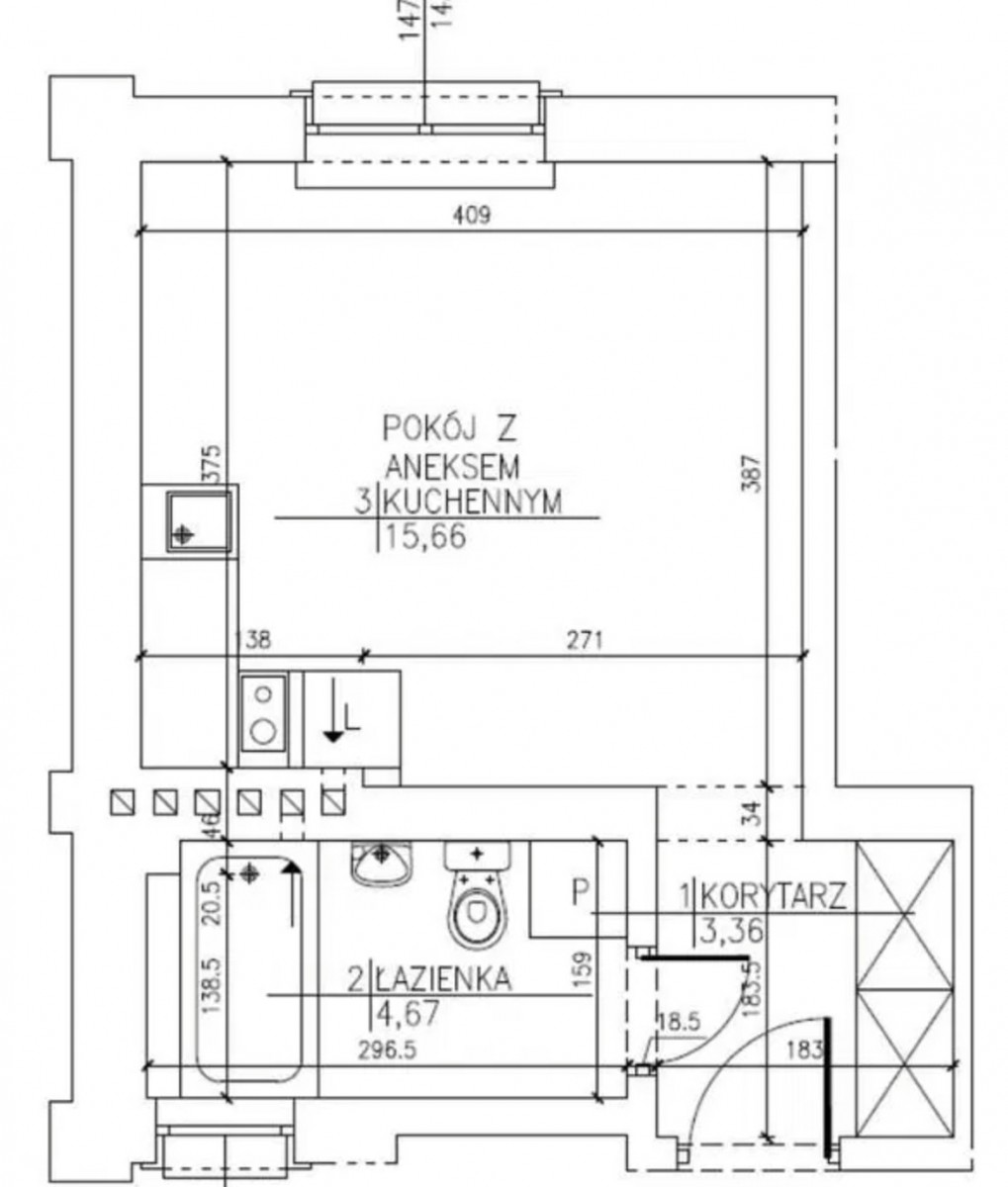
Why the Land and Mortgage Register Is Key to a Safe Property Purchase in Poland
05.04.2026Why the Land and Mortgage Register Is Key to a Safe Property Purchase in Poland